
Admission to master programmes with selection procedure (degree from another university)
Detailed information on the admission to the master programmes Computer Science and Media Informatics for prospective students who
- have completed a bachelor/diploma programme
- at another university/university of applied sciences than the University of Vienna.
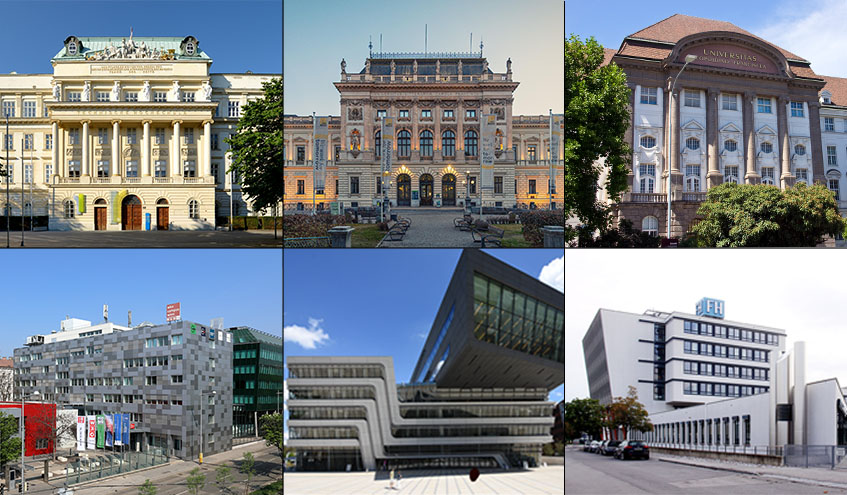
Fotos © Peter Haas (CC-BY-SA 3.0), Machno (CC-BY-SA 4.0), Bwag (CC-BY-SA 4.0), Nxr-at (CC-BY-SA 4.0), Steindy (CC-BY-SA 4.0)
Please note:
- Generally speaking you must have completed your degree programme when applying for admission. However, if you are near completion, an individual assessment of your study progress will determine whether you may participate in the selection procedure. No more than 30 ECTS may be left until completion. Please note: You have to submit your diploma before 30 September. Please merge your transcript of records into one PDF file. Upload this file in your application for admission, so your study progress can be assessed.
- You must hold an eligible higher education degree of at least three years from a post-secondary educational institution.
- Submit your complete application for admission with easily legible high-quality scans of your documents.
- The processing of your residence permit (if required) by the Austrian embassy/consulate takes time.
Deadlines and overview
- Application period for the academic year 2026/27: from 2 March to 7 April 2026
- Available university places: 85 (in total)
- Entrance exam: will not take place due to the decision of the Rectorate
- Administration fee: 50 Euro
- Exam language: English
- Exam duration: 90 minutes
- Admission period winter semester 2026/27: after the announcement of results to 31 October 2026
- Admission period summer semester 2027: from 11 January to 31 March 2027
- Semester start: 1 October (winter semester), 1 March (summer semester)
You can only be admitted to the degree programme in Computer Science and Media Informatics, if you have successfully participated in the selection procedure and fulfill all admission requirements.
Required documents
For the registration in u:space
- your valid passport or personal ID card (front and back) as JPEG or PNG file
For the application for admission
- Higher education degree certificate and transcripts/diploma supplement (at least 150 ECTS for a bachelor degree with 180 ECTS)
- with the completed subjects including grades and ECTS/semester hours
- with the required legalisation according to the issuing country
- with a sworn translation (if not issued in German or English)
- merged into one PDF-file
- note the info about degrees from non-EU/EEA countries.
- Curriculum vitae (CV)
- Letter of motivation
- Proof of English language proficiency
- Proof of other requirements prescribed in the curriculum
You can find detailed information regarding the content and structure of your letter of motivation and further documents on the overview page of the individual degree programme. Choose the appropriate degree programme at Admission > Master programmes.
You do not need a proof of German language proficiency.
Documents from Bangladesh, India or Pakistan?
Prospective students from Bangladesh, India and Pakistan also have to complete a competence check at VFS Global before applying for admission to a degree programme.
Your steps in the admission procedure
Step 1: Prepare the required documents
- Scan all required documents and save them in the appropriate format. Make sure that your files are easily readable and provided in high quality.
- Merge multiple pages of the same document into one PDF file using an online tool of your choice (e.g. higher education degree certificate + transcripts/diploma supplement + legalisation + translation).
Prepare all required documents before the beginning of the application period. Thereby, you can apply for admission with complete documents as soon as the application period starts.
Step 2: Apply for admission
- Create your u:account in u:space within the application period. Make sure to remember your login data. You will need your u:account during your studies.
- Log into u:space to complete the registration and select the degree programme of your choice.
- Upload the required documents. If you have prepared all the documents, it will only take a few minutes to submit your application.
- Check the summary to see if the data you have entered is correct (especially your e-mail address)
- Then, choose "pay and submit application" and pay the administration fee of 50 Euro by credit card or by eps online transfer. Afterwards your application is submitted. That means: you are registered for the selection procedure in the master programme in Computer Science/Media Informatics.
- In u:space > Personal matters > My documents you can find your registration confirmation which carries an official electronic signature. If necessary, you can present this document to the Austrian representative authority (embassy/consulate) to obtain an entry visa for the written test.
- The status of your application in u:space > Apply for admission > My applications has to be "submitted".
When the status of your application is "submitted" in u:space > Studies > Apply for admission > My applications, the Admission Office can process your application.
Missing documents delay the processing of your application. Only submit your application once you have uploaded all required documents.
Step 3: Prepare for the exam
To prepare for the exam, the following topics from the bachelor programme in Computer Science at the University of Vienna are recommended. These serve as the basis for this master programme. They are tested in a multiple-choice test.
Please note:
- The non-binding literature references are provided for orientation purposes only.
- All areas are equally important.
-
Technical Foundations of Computer Science
- Integer arithmetic
- Boolean algebra
- CMOS technology
- Logic gates
- Storage technologies
- Caching
- Scalar and superscalar computer architectures
- Basics of quantum computing
Literature for reference: John L. Hennessy, David A. Patterson: Computer Architecture: A Quantitative Approach. Elsevier. -
Theoretical Computer Science
- Propositional logic: Syntax: variables, logical connectives, formulas, conjunctive and disjunctive normal forms. Semantic: truth table, satisfiability of a formula, consistency of a set of formulas, tautology, logical implication (logical consequence). Proof of consistency of a set of formulas. Proof of correctness of logical consequence.
- First order predicate logic: Syntax: function and predicate symbols, terms, atomic formulas, free and bound variables, formulas, prenex normal form. Semantic: structures, models, satisfiability and validity of a first order formula.
- Formal grammars: regular grammar, context-free grammar, context-sensitive grammar, unrestricted grammar.
- Automata theory: finite-state automaton, pushdown automaton, Turing machine, deterministic and nondeterministic automata.
- Chomsky hierarchy: relationship languages/grammars/automata.
- Computability theory. Computable functions, decidable sets and problems. Undecidable problems. Halting problem.
- Complexity theory. Complexity classes P and NP. SAT problem.
Literature for reference: John E. Hopcroft, Rajeev Motwani, Jeffrey Ullman: Introduction to Automata Theory, Languages and Computation. Addison-Wesley. -
Mathematical Foundations
- Power set, operations with sets, cartesian product of sets, proof by mathematical induction
- N-ary, equivalence, and partial order relations
- Mappings and functions: injective, surjective, bijective
- Groups and rings as algebraic structures and their properties
- Vectors and matrices: basic operations, unit matrix, inverse matrix, rank
- Linear independence of vectors, basis and dimension of a vector space, coordinates in a vector space
- Linear systems of equations, Gauss algorithm and various uses of it
- Determinants, eigenvalues/vectors, characteristic polynomial of a matrix, similar matrices
- Scalar product, orthogonal vectors, orthogonal matrices, vector norms
- Graphs: directed, undirected, complete, planar, adjacency matrix, degree of a node, paths in graphs
- Trees and their characterization, properties of (regular) binary trees, Huffman codes
- Fundamentals: complex numbers, fundamental theorem of algebra, linear factors, Euler's formula, properties of different types of functions, exponential function incl. complex exponential
- Differentiation: limits, derivative, sign of derivative, critical points, implicit differentiation, logarithmic differentiation
- Integration: fundamental theorem of calculus, antiderivative, Riemann integral, integration by substitution incl. trigonometric substitution, integration by parts, improper integrals
- Sequences of Functions: uniform convergence, power series, Taylor series, Taylor series in several variables
- Differentiation in Higher Dimensions: vector-valued functions, Frenet–Serret formulas, partial derivative, tangent planes, directional derivative, total derivative, Jacobian, gradient, divergence, curl, Hessian matrix, definite quadratic forms, critical points
- Integration in Higher Dimensions: multiple integral, substitution for multiple variables, Jacobian determinant, polar coordinate system, cylindrical coordinate system, spherical coordinate system
Literature for reference: Kenneth L Kuttler: Calculus of One and Many Variables https://klkuttler.com/ -
Programming
- Programming Language Paradigms
- Imperative Programming, Variables, Assignment, Selection, Iteration, Sequence
- Algorithm Definition (Unambiguous, Effective, Deterministic, Finite, Complete, Correct)
- Recursion
- Object Oriented Programming, Data Hiding, Polymorphism, Inheritance
- Generic Programming, Templates (C++), Generics (Java)
- Lambda Expressions
- STL, Container, Algorithms (C++), Collections (Java)
Literature for reference: Bjarne Stroustrup: Programming Principles and Practice Using C++, Addison-Wesley. -
Database Systems
- Relational Model (Definition of Relation, Key, Superkey, Data Definition Language of SQL)
- Normal Forms (Functional and Multivalued Dependencies, 1.-4. Normal Form, Boyce-Codd-Normal Form, Decomposition- and Synthesis Algorithm)
- Relational Algebra (select, project, cartesian product, union, difference, intersection, division, join including inner, outer, equi-, and natural join)
- Tuple and Domain Calculus (formulas and expressions, quantors)
- SQL (select, from, where, set operations, aggregation, grouping, ordering, views)
- Transactions, (Concurrency and Recovery including schedules, locking, logging)
- Index Structures (B-trees and hashing methods)
- Relational Query Optimization (push projection, push selection, cost estimation)
Literature for reference: Ramez Elmasri, Shamkant B. Navathe: Fundamentals of Database Systems. Pearson. -
Algorithms and Data Structures
- Algorithm Paradigms, Greedy, Divide and Conquer, Dynamic Programming
- Asymptotic Computational Complexity (O, Omega, Theta, o, omega, ~)
- Data Structures (List, Trees, Graphs)
- Sorting Algorithm Properties (Insitu, Exsitu, Stable, Unstable, O(n ln n) Limit for Comparison Sort)
- Sorting Algorithms (Selection Sort, Insertion Sort, Bubble Sort, Quicksort, Mergesort, Heapsort)
- Linear Time Sorting Algorithms (Counting Sort, Radix Sort, Bucket Sort)
- Hashing Principles (Hash Function, Static, Dynamic, Collision Resolution)
- Hashing Methods (Double Hashing, Separate Chaining, Linear Hashing, Extendible Hashing, BISEH, Coalesced Hashing, Cuckoo Hashing)
- Search Trees (BST, Multiway Trees, B+ Tree)
- Graphs (Internal Representation, Traversal, Shortest Paths Algorithms)
Literature for reference: Thomas H. Cormen, Charles E. Leiserson, Ronald L. Rivest: Introduction to Algorithms. MIT Press and McGraw-Hill. -
Software Engineering
- Software Requirements Specification
- Software Verification and Validation
- Software Rollout and Maintenance
- Software Quality and Code Quality
- Software Design and Architecture
- Design Patterns
Literature for reference: Ian Sommerville: Software Engineering. Pearson. -
Modelling
- UML: Unified Modelling Language (UseCase, Class, Object, Activitiy, State, Sequence, Package, Component, and Deployment Diagrams)
- Entity Relationship Model
- BPMN: Business Process Model and Notation
- DMN: Decision Model and Notation
- Petri Nets
- Event-driven process Chain (EPC)
Literature for reference: Martin Fowler: UML Distilled: A Brief Guide to the Standard Object Modelling Language. Addison Wesley. -
Computer Networks
- Physical Layer: Guided Transmission Media, Wireless Transmission, Spectra and Waveforms
- Data Link Layer: Framing, Error Control, Flow Control, Media Access Control, Ethernet, WLAN
- Network Layer: Internet Protocol, Routing Algorithms and Protocols, Traffic Management and Quality of Service
- Transport Layer: UDP and TCP
- Application Layer: Domain Name System, Electronic Mail, World Wide Web
- Fundamentals of Network Security: Attacks, Symmetric-Key and Public-Key Cryptography, Digital Signatures
Literature for reference: James F. Kurose, Keith W. Ross: Computer Networking. A Top-Down Approach. Pearson. -
Human Computer Interaction
- Human-Centered Design (User research)
- Usability and User Experience
- Interaction Design Principles
- Accessibility and Inclusive Design
- Emerging Technologies in HCI (GenAI)
- Perception and Cognition
- Prototyping
Literature for reference: Alan Dix, Janet Finlay, Gregory Abowd, Russell Beale: Human-Computer Interaction. Prentice Hall.
Step 4: The written exam
No later than 14 days before the written exam, you will receive information by email about the location, time and procedure of the written exam. Keep the entire test day free and, if necessary, arrive the day before.
Print out the permission to attend and bring it with you on the day of the exam.
At the end of the exam, you will be informed about the next steps. Approximately 14 days after the exam, you will be notified by email about the result and the next steps.
The admission to the degree programme is only possible after you have successfully passed the written exam and received your admission letter.
Step 5: Waiting for the test result and admission letter
Wait for the test result
Approximately 14 days after the exam, you will receive an e-mail with your results and the next steps. This takes several weeks.
Wait for the admission letter
As soon as the test results are announced, your application can be further processed. Missing documents will delay the processing of your application! So make sure, that you have uploaded all required documents in your application.
You will receive your admission letter via e-mail to the e-mail address you have provided in u:space. The admission letter is only valid for the winter semester you have applied for and the following summer semester. We recommend starting your studies in the winter semester.
Having received the admission letter does not mean that you are already admitted to the degree programme, but rather that you have received a study place and that an admission to the degree programme you have applied for is possible. You still have to complete the admission procedure as described in step 6 and 7.
Step 6: Admission to the degree programme
This is how you complete the admission procedure:
- Log into the Servicedesk with your u:account and let us know to which degree programme you want to be admitted to.
- We will admit you to the programme within the admission period. Please note: The University of Vienna reserves the right to invite you to an online appointment.
- Once you have been (preliminarily) admitted, you will receive an e-mail containing important information. Please read this e-mail carefully.
Step 7: Pay the tuition fee/Students' Union fee and order the u:card
Pay the tuition fee/Students’ Union fee. The admission is complete as soon as the prescribed fee is "received" in u:space > Financial matters > Tuition fee/Students’ Union fee. Then you can order your student ID card, the u:card.
You can also print your study documents (student record sheet and confirmation of enrolment) in u:space > Personal matters > My documents.
After admission you can plan your semester and register for courses. The registration deadlines are available in the course directory u:find as well as in u:space.
FAQ
-
How can I pay the administration fee?
You pay the administration fee by
- credit card or
- eps transfer (only possible with an Austrian bank account).
As there are no other payment options available for technical reasons, a trusted person can also make the transfer on your behalf. Do not forget to select the "Submit application" button. You will only be registered for the selection procedure once you have paid the administration fee and submitted your application.
-
I don't live in Austria. How can I participate in the written exam?
We advise everyone to travel to Vienna the day before.
Please note: There are no alternative dates and there is no possibility to take the test online!
Citizens of non-EU/EEA countries are advised to enquire about entry requirements at an Austrian representation as soon as possible.
If necessary you can apply for a residence permit/visa with your registration confirmation which carries an official electronic signature.
-
I cannot or do not wish to attend the exam. Will I get a refund for the administration fee?
No. The administration fee is a specific regulatory measure. The aim of the administration fee is to ensure that only those who are interested in studying apply for admission. The administration fee cannot be reimbursed if you do not participate in the test or if the test does not take place. This has been confirmed by the judicature of the Constitutional Court (only available in German).
-
Which reasons for reimbursement of the administration fee exist?
A reimbursement of the administration fee is only possible for the exceptions listed below. Does one of the exceptions apply to you? If so, please send us the relevant proof via the Servicedesk. Please enter "reimbursement administration fee" as the subject of your request.
- Double payment of the administration fee
If the administration was deducted from your bank-account twice, the extra payment will be reimbursed.
Proof: Payment confirmation - Ownership of an identity card for displaced persons
If you own an identity card for displaced persons (blue card), the administration fee will be reimbursed. Proof: Scan of the front and back of the identity card for displaced persons and payment confirmation
There are no other reasons for reimbursement.
- Double payment of the administration fee
-
Can I submit the application with a certificate for English that is not in the list of accepted certificates?
No, only language certificates listed as recognised proofs of English language proficiency are accepted.
-
I have received my admission letter, what do I need to do now? Am I already admitted to my degree programme?
No, you still have to complete the admission procedure as described in step 6.
-
Do I have to be admitted to be able to travel to Austria?
If you hold a non-EU/EEA citizenship, contact the responsible Austrian representation (embassy/consulate), to inquire if you need a residence permit for Austria and how to enter the country. The Austrian representation will inform you about the required documents for your application for a residence permit.
-
Do I need a proof of German language proficiency at level A2?
Among all master programmes with selection procedure, only the master programme in Psychology and the master programme in Psychotherapy are instructed in German. For all other master programmes with selection procedure no proof of German language proficiency is required.
-
When will I know if I can be admitted?
You will receive your admission letter a few weeks after taking the written test. You can only be admitted after successfully participating in the test and receiving a positive admission letter.
-
My bachelor programme is not yet completed. Can I still apply for admission?
Generally speaking you must have completed your degree programme when applying for admission. However, if you are near completion, an individual assessment of your study progress will determine whether you may participate in the selection procedure. No more than 30 ECTS may be left until completion. Please note: You have to submit your diploma before 30 September. Please merge your diploma supplement into one PDF file. Upload this file in your application for admission, so your study progress can be assessed.
-
My documents are from a non-EU/EEA country. Is there anything else I should keep in mind?
If your documents are from certain countries you have to fulfil specific requirements. Detailed info about all additionally required documents is available on our website for students from third countries.
Please also keep in mind that your documents might also have to be legalised (depending on the issuing country).
-
How long is my admission letter valid?
Your admission letter is valid for the winter semester you applied for and the following summer semester. We recommend beginning your studies in the winter semester.
-
I can't find my master programme in the list in u:space – why?
Please note that the application periods for admission to master programmes with selection procedure and master programmes without selection procedure differ. Make sure, if the application period for the desired master programme is currently open. Only then will it appear in the drop-down menu.
-
How many study places are available each academic year?
Each academic year 85 study places are allocated for Computer Science and Media Informatics.